A couple of years ago I started tracking books in The StoryGraph. I had become more intentional about my nighttime routine, including 30 to 60 minutes of reading before sleep, and I decided to be more intentional about tracking my thoughts on each book as I completed it. This forced me to reflect on things I thought worked or didn’t work in each case.
This practice really deepens my enjoyment of reading. Even if the whole book doesn’t quite come together, I can almost always find some aspects to appreciate. And if there is something that I don’t think works, I can confidently skim over those parts while still enjoying the areas that do hit, and it doesn’t feel like I’m wasting time.
Since this is the first complete calendar year of my tracking, these stats are presented in something of a vacuum. But I enjoyed reviewing my summary, and reminding myself of my thoughts on the top and bottom scorers.
2025 in review
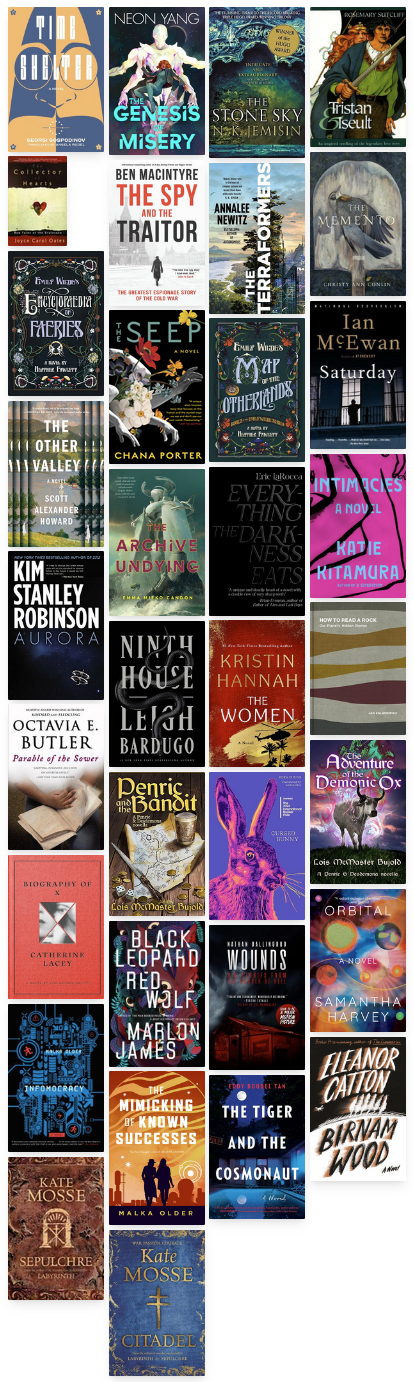
In 2025 I completed 34 books. The longest was “Citadel” by Kate Mosse at 696 pages, and the shortest was “Penric and the Bandit” by Lois McMaster Bujold at 123 pages.
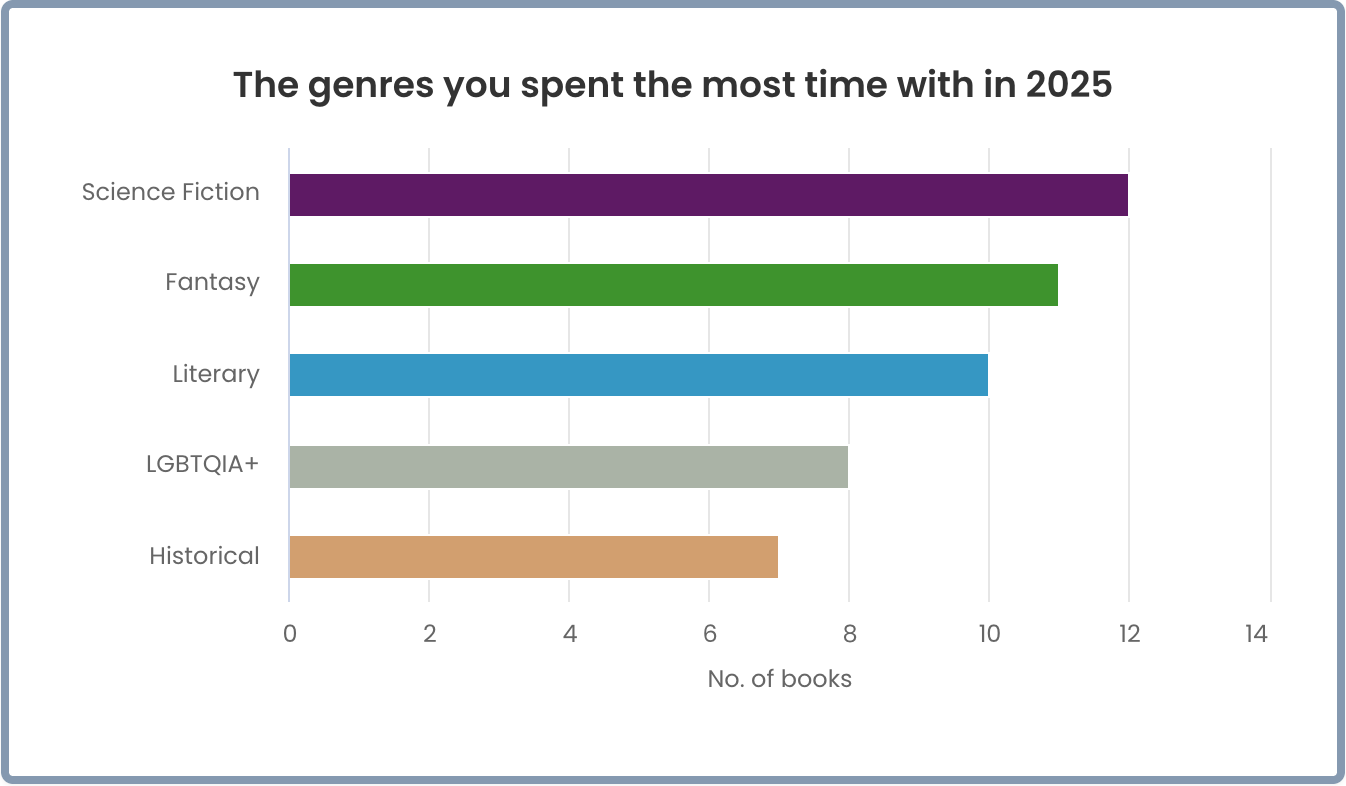
The genres covered match my preferences! Note that books can belong to multiple genres.
I was particularly interested in my ratings data, though. I often find that 5-point scales get compressed so that “Like” translates to either 4 or 5 stars; or we get into half-star territory where it’s really hard to characterize 10 different levels. So at the start of my StoryGraph journey I made a conscious decision to rate according to my own scale of:
- 5⭐️: Enjoyed the process of reading; appreciated the thoughts conveyed; no negatives!
- 4⭐️: Enjoyed the process of reading; appreciated the thoughts conveyed; but there was something that didn’t quite sit right (maybe a poor characterization, a dull section, a bit of Deus Ex Machina, etc).
- 3⭐️: A solid recommendation for a positive experience! It might not be the best written, the most engaging, or the deepest intellectual ideas, but it probably has 2 out of the 3 and overall there was something charming that hooked me.
- 2⭐️: Pretty decent! There might not be anything specifically redeeming that should make you push through if the concept doesn’t appeal, but if something about the setting, characters, or plot is to your taste, you’ll probably have a good time with it.
- 1⭐️: I completed it, so there is something intriguing about this book that I appreciated. But it’s hard to recommend this for anyone who doesn’t already have an interest in reading it.
- 0⭐️: Did not finish; recommend against reading.
This means that the full scale of 5 stars is available for grading. I can get nuanced about how much I liked something, while having a fairly clear rubric for each point on the scale.
But I was really curious if I’d actually be able to truly use my scale, and resist the tempation to 5-star or 1-star everything! The evidence suggests yes, as my average rating was 2.94 stars, and the distribution looks reasonably Gaussian:
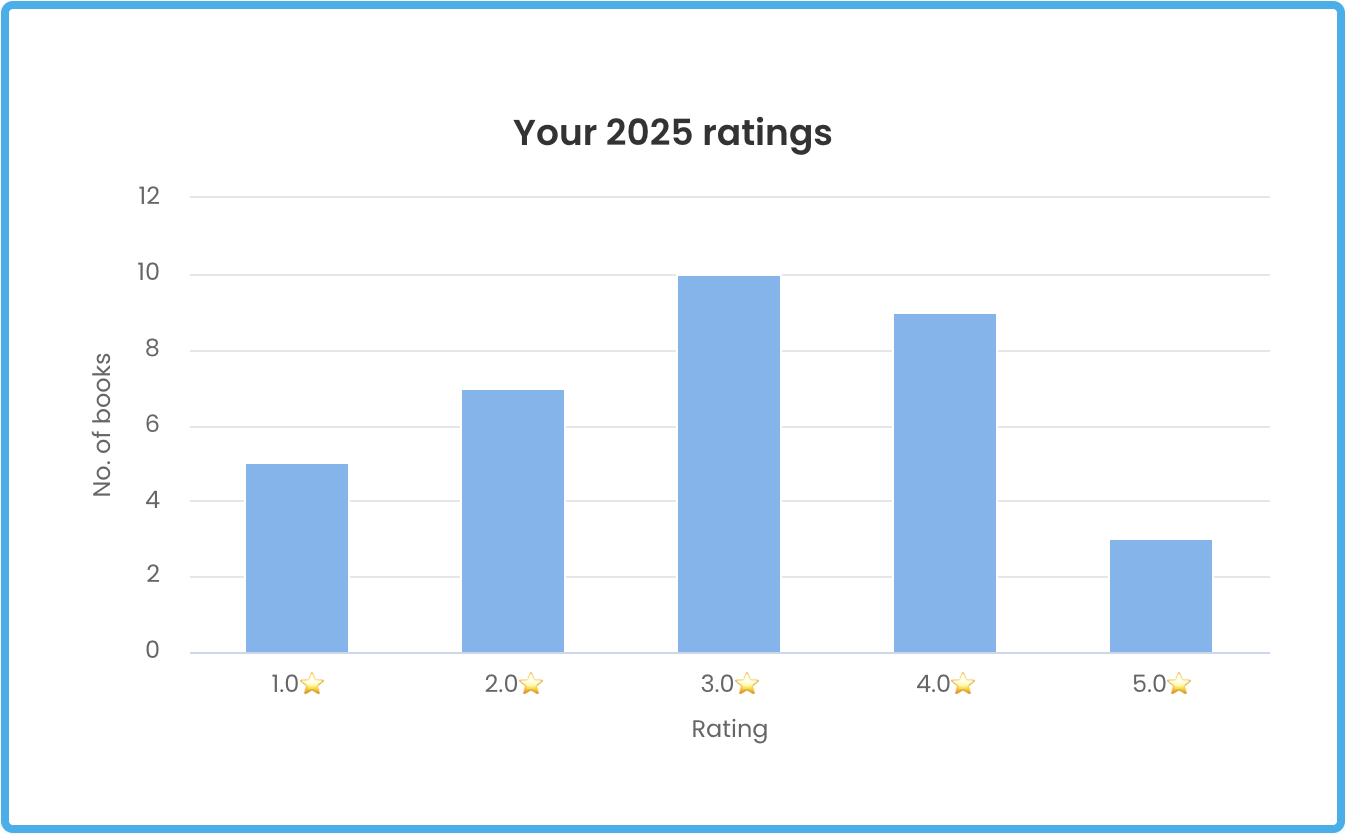
If anything I’ve perhaps over-used 4-stars at the expense of 5-stars, but it’s difficult to call something a perfect book.
Notable books
The overview statistics were interesting, but I also wanted to review the books that made it to the top and the bottom of the list.
The 5-star books, and why you might like them
- “Emily Wilde’s Encyclopaedia of Faeries” by Heather Fawcett. An unexpected gem! The story follows academic Emily Wilde as she performs fieldwork in a remote village to gather data for her magnum opus. A fantasy story with a diverse cast, which gave me “Jonathan Strange and Mr Norrell” vibes.
- “The Other Valley” by Scott Alexander Howard. The story of a young girl reaching adulthood and making important life decisions, in the context of a science fiction-esque time travelling ability, but written like literary fiction. (And I mean GOOD literary fiction: no MFA first novel clunkers here.)
- “Parable of the Sower” by Octavia E. Butler. Unbelievably prescient story written in 1993 and set in 2024 about the slow collapse of society, and a generation of children born into it, as told through the eyes of one particular girl. A masterpiece, although not an enjoyable read in the same way as “Emily Wilde”.
The 1-star books, and what I got out of them
- “Orbital” by Samantha Harvey. A day in the life of the astronauts aboard the International Space Station. Written in a very dry and distant style; it was hard for me to connect with the characters. When the whole book is so character-driven and interior, it’s a strange choice to keep them at arms length. I guess it matches the theme of astronauts being so distant and disconnected from Earth, but it just made it an un-enticing read for me. The descriptions of the day-to-day of how the astronauts live were interesting, though. It’s a short read, which is why it’s not a “Do not read”.
- “Black Leopard, Red Wolf” by Marlon James. There is a lot that I liked about this book, and it’s firmly in the territory of “Give it a try if it sounds appealing”. The story integrates African traditional fantasy elements, including animal-to-human shapeshifters, witches, river spirits, and others. However, this book desperately, DESPERATELY needed an editor! It comes in at 620 pages, but could easily have been cut to 400 by removing redundant descriptive passages, or 300 by removing the more peripheral plot events. The trouble with so much description is that it becomes overwhelming, and I started to lose sight of the overarching plot or specifics of why we’re in a particular forest or city. A skimmer, if it sounds intriguing.
- “Everything the Darkness Eats” by Eric LaRocca. This was super disappointing, as I love Eric LaRocca’s horror short stories. But traits that work for a short story just can’t be sustained over the length of a novel, such as lack of character progression, stunted narrative arc, and melodramatic prose. Additionally, the events and character attitudes are very regressively homophobic, without even the excuse of a comeuppance at the end. Overall a very jarring reading experience, and in retrospect this is probably a “Do not read”.
- “Saturday” by Ian McEwan. Hard to get into. It’s very internal: it’s the main character’s thoughts and feelings as he goes through a single day (a Saturday) in 2003. I found many of his thoughts and preoccupations tedious, especially in the first 80 pages before anything starts to happen. I liked the nostalgia of remembering the collective worries in the UK in 2003 (eg the war in Iraq was just about to begin). But the main character is just a fairly boring guy with prosaic thoughts and lacking conviction in any specific course of action. This is very realistic, of course, but it doesn’t make for a gripping 300 pages.
- “Time Shelter” by Georgi Gospodinov. An interesting premise: the main character Gaustine opens an institution for Alzheimer’s patients where each floor represents a different decade, but regular people sign up to retreat from the difficulties of the present. The language is playful and full of allusions, which can be fun (and the translator did a good job!). But I kept expecting there to be more: more of a reason why the narrator and Gaustine were separate and together, more of an explanation for where Gaustine came from. Interesting summary of periods of European history in the last century, and some scenes gave good insight into what it was like on the Eastern side of the Iron Curtain. But ultimately I found the book unsatisfying.
The book collage
Finally, here is the collage of covers generated from my reading in 2025. If you’re interested in more book thoughts, I’m @vcatterson on The StoryGraph.