Predicting Remaining Useful Life of Transformers
Transformers are the most expensive components of power networks. Over time, the heat within a transformer causes its paper insulation to become brittle. Eventually, the paper loses its mechanical strength entirely, and the insulation disintegrates. There is no practical, cost-effective way of measuring the remaining strength of the paper. Utilities need predictive tools to estimate the remaining useful life (RUL) of their transformers based on ambient conditions.
The Data Science
There is an IEEE standard which gives an equation for the rate of transformer aging, given the ambient temperature and transformer current. However, this deterministic model doesn’t take account of the uncertainties in this process (such as measurement error and initial paper strength).
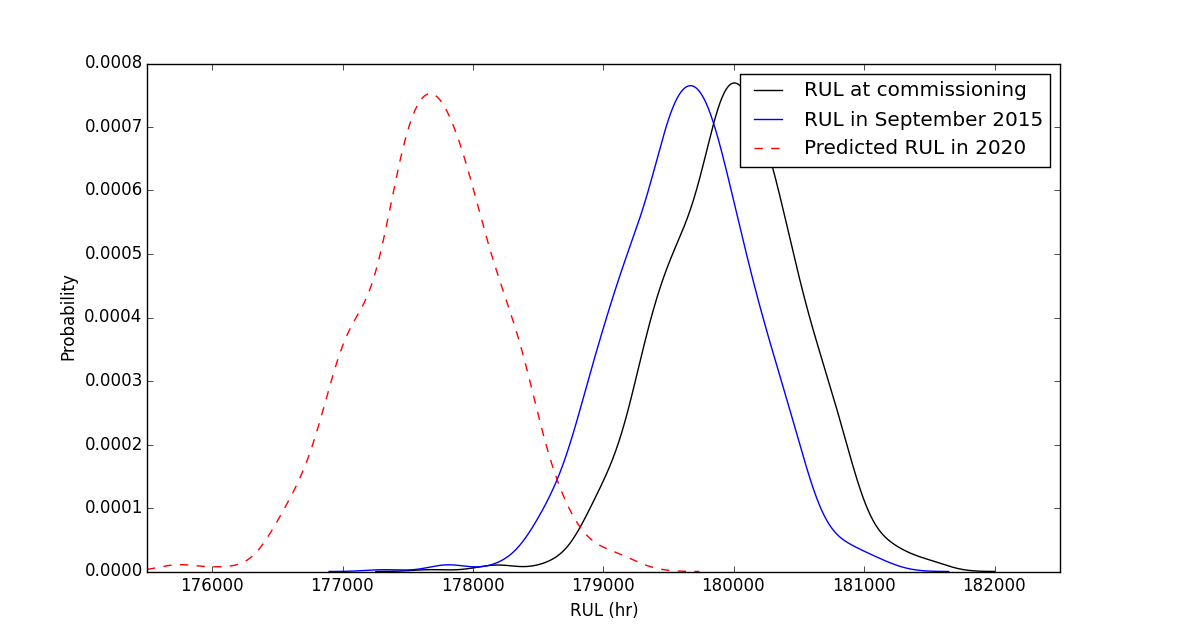
I proposed adding a probabilistic layer to this model through Bayesian particle filtering. By quantifying the sources of uncertainty, the model can give a probability density function (PDF) of remaining transformer life, instead of a point estimate.
Results
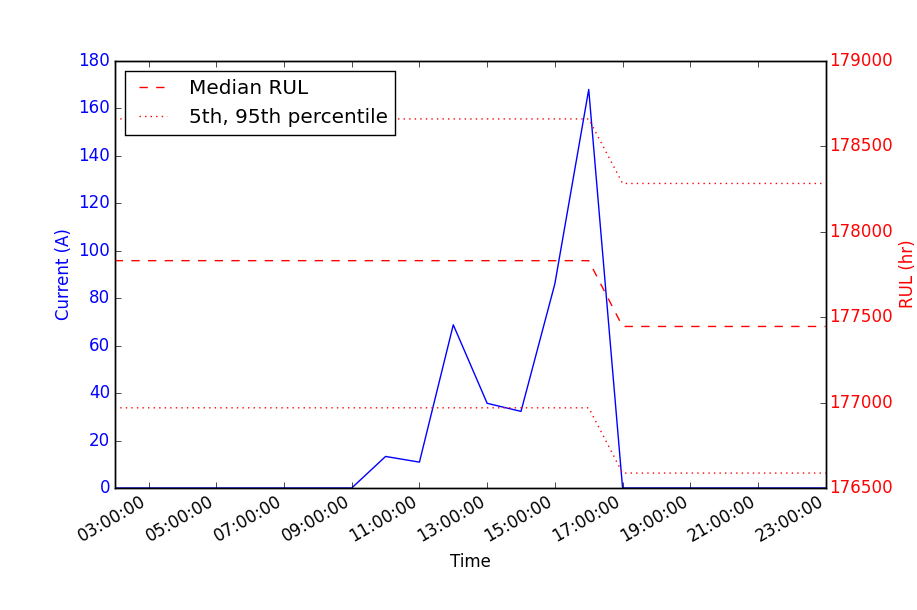
I identified the key sources of uncertainty in the IEEE model, and proposed appropriate ways of quantifying them by drawing on the most up-to-date research in the literature. I built a version of the probabilistic model for an in-service transformer in Cumbernauld, Scotland, and used this model to predict remaining useful life of the transformer under normal conditions, and under overload conditions. This gives engineers a tool to speculate about the effects of overloading the transformer in emergency conditions.
Resources
Papers detailing this work: